


AI is better at helping a marketer write code than at helping a programmer do marketing.
Maybe that flips one day. In October 2026 it hasn’t, sorry.
Put the pitchforks down for a second, though. I’m not here to dunk on engineers. Plenty of tech bros (and a few Reddit commenters you’ll meet further down) believe knowing how to code puts them above marketers. Shipping things with AI doesn’t put me above engineers either, and I’ll never claim it does. That kind of ranking is unfair whichever way you point it. I will never do what a good engineer does. Me plus AI loses to an engineer plus AI at engineering every time, same as I’d lose to a designer plus AI at design.
What AI did was make shipping accessible to people like me. The people you’re marketing to stayed exactly the same: humans.
And that’s why I don’t think marketing gets “solved” in our lifetime, at least not the way a lot of engineers would like. Their solved version is a closed loop. My agent markets to your agent, your agent haggles with mine, and nobody ever needs taste again.
Anyone interested in the cyberpunk genre has seen this world already. Episode two of Psycho-Pass: Akane wakes up and a jellyfish-shaped holographic assistant reports her mental state, tells her how many calories she gets at breakfast and keeps her on a diet, while she flips her apartment between hotel interiors and picks outfits from presets. Or Blade Runner 2049, where K comes home to Joi, a holographic companion projected from a console in his apartment, and the same product towers over Los Angeles as a giant hologram ad promising to be whatever you want. That’s 2049, and somebody STILL had to market the AI to a human.
Credit where it’s due: this piece exists because of a TikTok from Eugene Healey, who makes videos about brand and culture. He reckons tech bros will end up saving the marketing industry by accident, as they learn firsthand that marketing is a real skill set. I’m mostly with him. And a handful of Redditors spent this weekend proving him right, using me as the example.
The short version
AI made building cheap, and it can run the mechanical side of distribution too: ads, assets, schedules, reports. Making you different is beyond it, yet different is the only thing that stops a human mid-scroll. So once everyone ships with the same tools, good marketing is the moat, and it stays the moat for as long as buyers are people. Our lifetime, at minimum.
Shipping got cheap. Standing out didn’t.
The best line in Eugene’s video is aimed at founders who figure AI can just run their marketing. Sure, AI can define your positioning, build the plan and make the creative. In his words, it “doesn’t really matter if you have nothing to say.”
Miranda Shanahan landed somewhere similar in TIME this summer. Tech leaders, she notes, have started calling taste the new core skill. She also cites Snap CEO Evan Spiegel: once AI makes products easy to build, distribution turns into the biggest challenge.
I’d go one step further than both of them. At the mechanical level, distribution is mostly workflowable now. I build workflows for ad launches, creative variants, posting schedules and reporting all the time. The part no workflow touches is the part that makes a person stop scrolling, which is being different. AI averages everything. Ask it for a launch plan and you’ll get the median launch plan, the one ten thousand other founders also got this morning. That’s where slop comes from - the lack of context. You end up as noise in a sea of noise, and nobody cares about noise. Even in AI workflows, where context is the new king (and trust me, I know a lot about context engineering) it still is not enough.
Look at whose marketing gets praised right now: nobody manages to clone them. Clay raised $115 million at a $7.1 billion valuation in September 2026, more than double what it was worth a year earlier, after turning “GTM engineer” into a job title thousands of people now carry. PostHog hit a $1.4 billion valuation in 2025 talking to developers in a voice that sounds nothing like standard SaaS copy. People try to copy both of them with AI all the time, and the format copies just fine. The point of view behind it won’t come along, so the copies read like copies.
Cluely is the other half of the lesson. Its “cheat on everything” launch got 70,000 signups in week one and a $15 million Series A led by Andreessen Horowitz. Everyone’s tried to replicate that playbook with AI since, and the copies mostly fail. Then in March 2026 the CEO admitted the $7 million ARR figure he’d given TechCrunch was false. Cluely has since narrowed into an AI meeting notetaker, and he’s conceded that viral hype alone won’t carry a software company. Standing out got them in the door. Good marketing also needs something worth standing out for.
My weekend experiment: 27,500 views and a lot of angry developers
Every so often I build a small game, purely for fun, not profit. My “niche” is pixel style, short and simple, each one a single HTML file. I make them with AI because I’m not a developer, and I don’t pretend to be. Two are on my itch.io page so far. Kryptvault came out a few months ago and got a polish this weekend. Land of ASCII went live a couple of days ago.
Every game gets the same goal, 100 plays in the first 48 hours. Kryptvault made it. Land of ASCII got some organic marketing: posts in seven subreddits plus a couple of brand-new social accounts. These are its first 24 hours, and the numbers were still climbing when I wrote this.

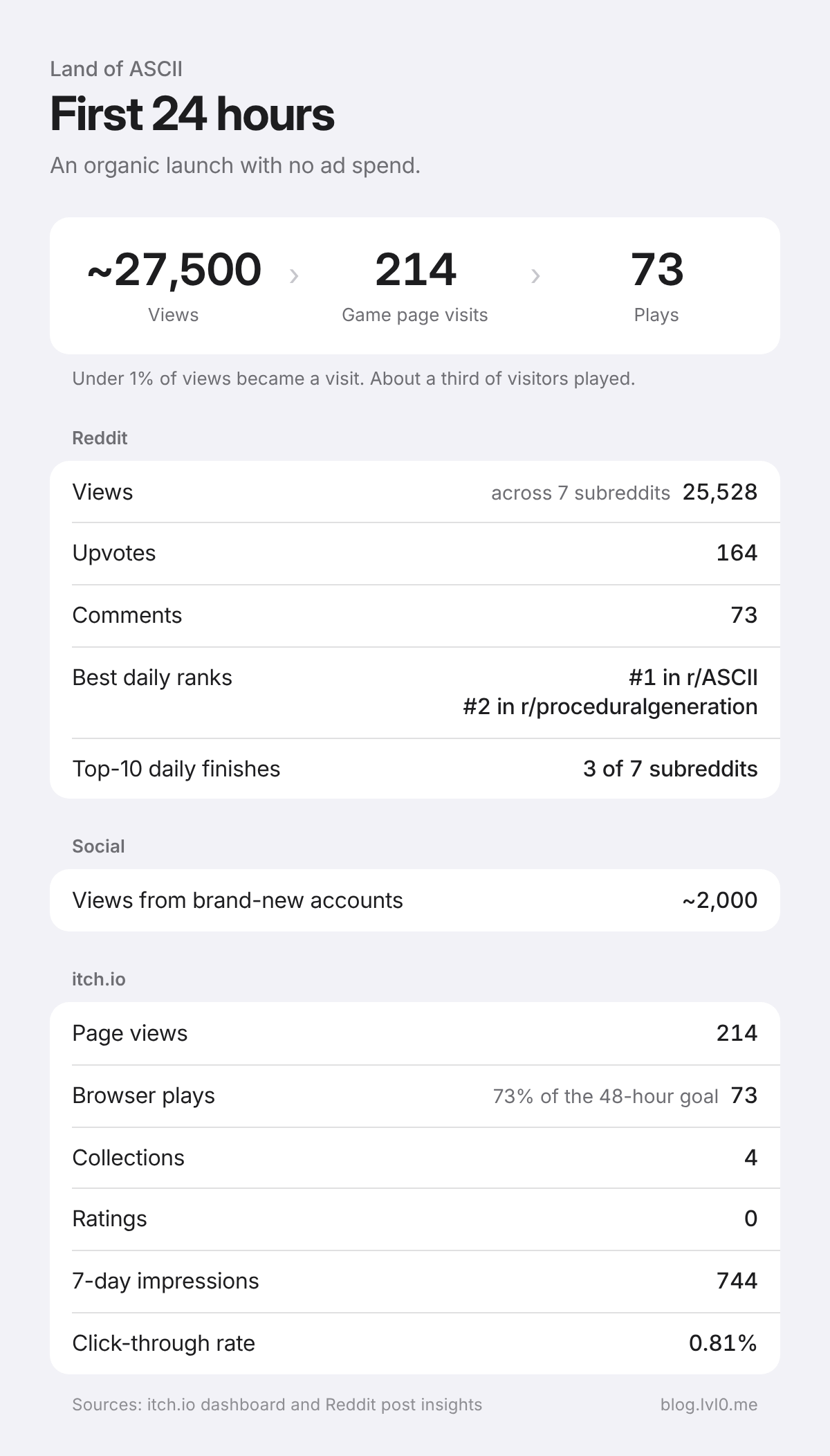

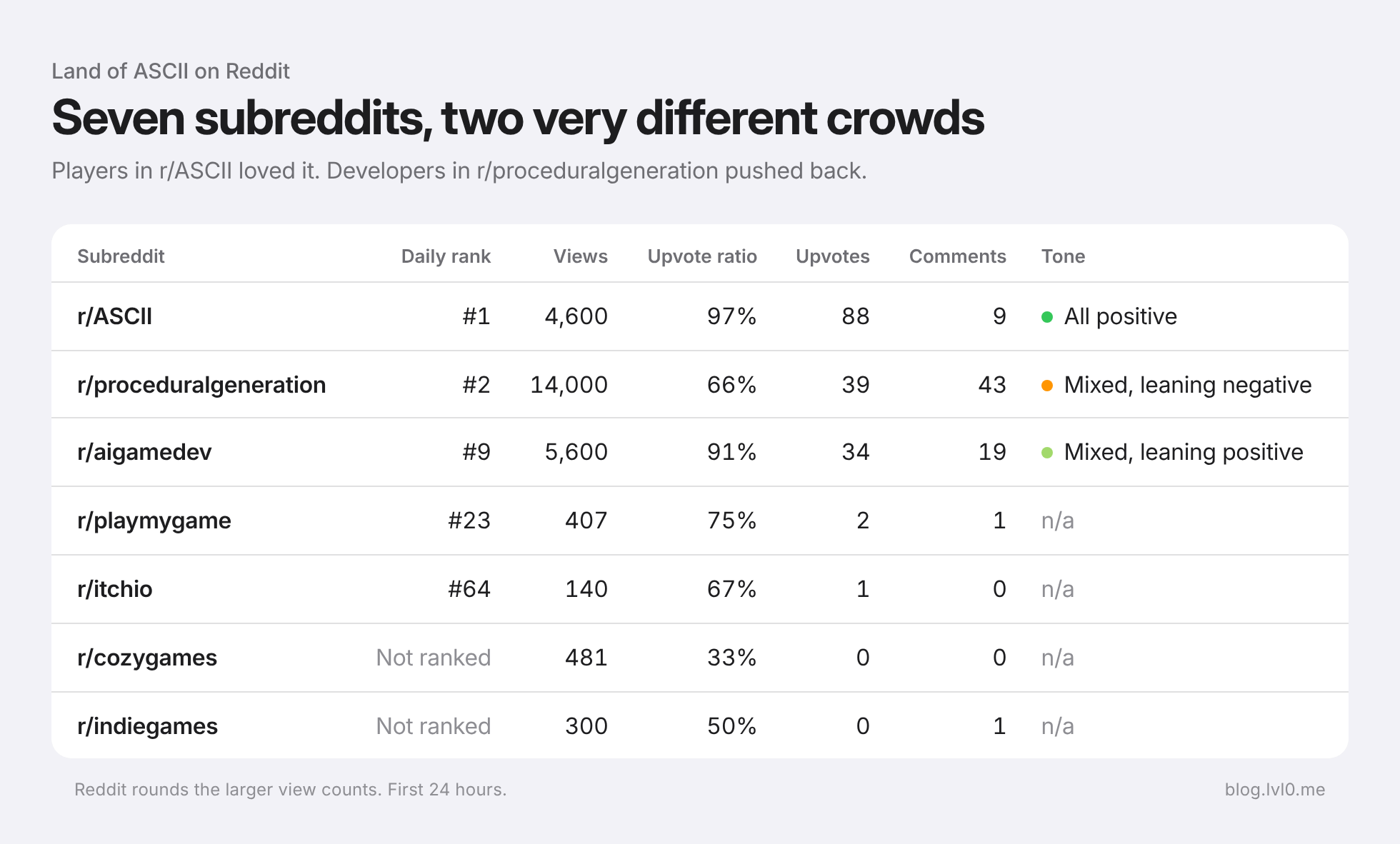
The biggest audience came from r/proceduralgeneration, and so did the most anger. 14,000 views, a 66% upvote ratio, and over half the comments I categorized were negative. Some of it was fair criticism (more on that below). Plenty of it was about who I am rather than what I made.
“OPs bio claims he is a marketer which explains everything. i despise these types as a technical individual.”
“i dont f*ck with marketing bros sorry”
“its a vibe coded project - which is fine if the dev actually understands what they made. this guy clearly doesnt”
“Prompt Engineer 63478279937 comes in here and proudly boasts of something they “”“made”“”. They must deep down know they contributed nothing so why are they presenting it as theirs? Are they that starved for attention??”
I replied to explain myself and got told I hadn’t written my own comment. Over in r/aigamedev, of all places, someone reviewed the whole game in one word: “slop.” Someone else went with “Ew.”
Over in r/ASCII, where the players hang out, it was a different story: a 97% upvote ratio, #1 post of the day, not a single negative comment. And one r/aigamedev user ranked it among the top 10 projects they’d seen that month and said they’d write about it.
No score-settling here. Read them a second time, though, and notice what’s getting under people’s skin. These folks can code, and plenty of them understand rendering way better than I ever will. The post that got a little text-rendered world in front of 14,000 people still came from the marketer. What bothered them was the attention, more than the game.
And some of them were right, so that’s the part I’m keeping. Most of the pushback came from the “made entirely of ASCII characters” line, so the game is getting reframed as a text-rendered 3D world. Players liked “One 1 MB HTML file”; developers couldn’t care less. But makes a point; let's continue. Btw, try my other game:

From the outside, marketing looks like a to-do list
In my experience, plenty of engineers picture marketing as a checklist. Doing Meta ads. Setting up an event in Luma. Doing analysis on a report. Each item reads to them as a bunch of clicking on a screen, and clicking is exactly what automation is for.
Half right. Clicking is the boring part and none of us love it. Take it, I’ll happily hand it over. Clicks are only the mechanical layer, though. Pull out the critical thinking, the vibe, the sixth sense for what a specific audience will respond to, and the creativity, and every one of those tasks goes soulless. You get an ad nobody remembers, an event nobody shows up to, a report that recites numbers and never tells you what to do next. Anyone who thinks marketing can be automated is staring at the part that can.
AI will absolutely help you brainstorm, and it’ll draft, sort, summarize and spin up variants all day long. What it won’t do is pull a rabbit out of your ass. Somebody who understands the people on the other side of the screen still has to come up with the idea. My e-commerce operations breakdown goes through this function by function: AI is excellent at creating, decent at deploying, and still weak at any analysis that takes judgment.
There’s another reason marketing looks easy from outside, and it’s who tends to do the work. For a lot of my career I’ve been the only guy in the room. Marketing is female-dominated; the ANA data Shanahan cites puts women at roughly 67 to 70% of practitioners. Her TIME piece makes a sharp case for how that affects the way the work gets valued, and why tech keeps slapping “engineer” onto marketing job titles. I won’t relitigate it here. Go read hers.
Growth ninjas, bridges, and why I keep upskilling
On paper you could file me under “growth,” and I’ve always found those titles kind of bullshit. Growth hacker, growth ninja, wtf. TIME’s list of the 2026 versions includes “Narrative Engineer” and “UGC Engineer.”
The one time an engineering title for marketers did work, it was a marketing move, which I find pretty funny. Clay put “GTM engineer” on the map deliberately, as a category play, and the title now sits at the center of how a $7 billion company positions itself. It landed because Clay knew exactly who it was naming and why they’d want to wear it.
I do believe hybrids are the future, as the people who close gaps and build bridges between departments. The uncomfortable bit is that AI makes some of those bridge jobs obsolete. With good tools, one person can now cover the basics of several functions, and for the big stuff you still call in a specialist. Everyone in the middle gets squeezed: the people whose whole job was translating between marketing and product, or between sales and engineering. That sucks for anyone who built a career in those niches.
I had one of those jobs myself. The expiry date was visible even then, because I had no specialist function: I WAS the bridge. Upskilling started right there and never really stopped. These days I make games, market them and work in AI engineering, and bridging is just one of the things I do.
The steelman: “most human marketing is slop too”
Human slop is real.
Anyone in design remembers the Facebook groups before COVID, packed with “designers” charging a tenth of the going rate for garbage visuals and garbage videos. Most of what AI spits out today beats that stuff. Plenty of those people thought they were good, and I do feel sorry for them. But not everyone needs to be a creative, sorry.
Whoever bought that work was never your client, though. Same goes for AI today: the food stand with an AI-generated menu was never going to hire you anyway.
Where I stand on generative AI is somewhere in the middle, nowhere near all-in and nowhere near against. AI slop visuals and AI copywriting drive me nuts, so I don’t shop there and I don’t produce that crap myself. My workflows are fairly sophisticated, and most people looking at the output wouldn’t think to ask whether AI was involved. Which was never the point. AI works as an extension of my brain, an assistant, and the brain stays mine.
The objection I take more seriously is about agents. Once we’re selling to agents instead of humans, the argument goes, marketing is solved.
As a cyberpunk fan, I think that world does arrive in some shape. Not in our lifetime, though. People adapt slowly and accept change even more slowly. Agent-to-agent buying only feels normal once a whole generation grows up treating it as a commodity from day one. Until then it’s humans marketing to humans.
Putting an agent in the loop doesn’t take the human out of it, either. The 2026 B2B buyer research I dug through had 94% of buyers fact-checking whatever AI told them. And 69% would rather validate AI-generated insights with a sales rep than trust the AI on its own. So the agent researches, and a person still signs.
Prompting never got you anywhere anyway
There’s a step the “AI will run our marketing” crowd skipped. A single prompt has never gotten anyone anywhere. Good output takes context engineering, rounds of iteration and proper workflows. By that point you’re grinding through a tedious job, the very one you thought an agent would knock out in five minutes. Strive for quality and the five-minute version fails every time.
My six-hour rebuild of a broken $42,000 agency campaign was six hours of workflows plus checking every link and image against the approved brand set, and that only works if you already know what a broken launch looks like. In the short-form video playbook I pointed out that tl;dv spends about six hours per video from idea to post, and no AI avatar gets you near that. The buyer journey piece found the average B2B shortlist is 2.7 products, so you’re fighting to be one of three names a buyer already trusts, and sounding like everyone else won’t get you on it. (Founders whose marketing hire keeps pushing back on their ideas: I wrote about you too.)
Build with AI, by all means. That’s how I spend most weekends. Just know that getting people to care about what you built is a separate job, and it’s still marketing. Humans are still the ones you’re marketing to.
Want to support me what I do? Consider sharing this article!
Frequently asked questions
Can AI do your marketing in 2026? It can take a lot of the mechanical work off your plate: drafting ads, generating creative variants, scheduling posts, summarizing reports. Deciding what makes you different, or predicting how a specific group of people will react, is still on you, and that’s what gets a human to notice and remember you.
Why is good marketing a moat in the age of AI? AI lets almost anyone build and ship a product fast, so products start to look alike. What’s scarce is getting the right people to notice and remember you, and that runs on positioning, taste and judgment. AI can help with those. It can’t supply them.
Will AI agents eventually replace marketing to humans? Some version of that future probably arrives, just not in our lifetime. AI is already part of B2B buying, and still 94% of buyers fact-check what it says while 69% would rather validate its output with a sales rep.
Isn’t most human-made marketing generic too? Yes. Human slop was around long before AI slop, and whoever buys either kind was rarely a client good marketers were after anyway.
Can a non-developer ship a product with AI? Yes, I do it as a non-developer: small browser games, built and shipped with AI. The shipping part is accessible now. Making people care about what you shipped is its own skill, and AI helps least with that one.