


Last updated: August 2026
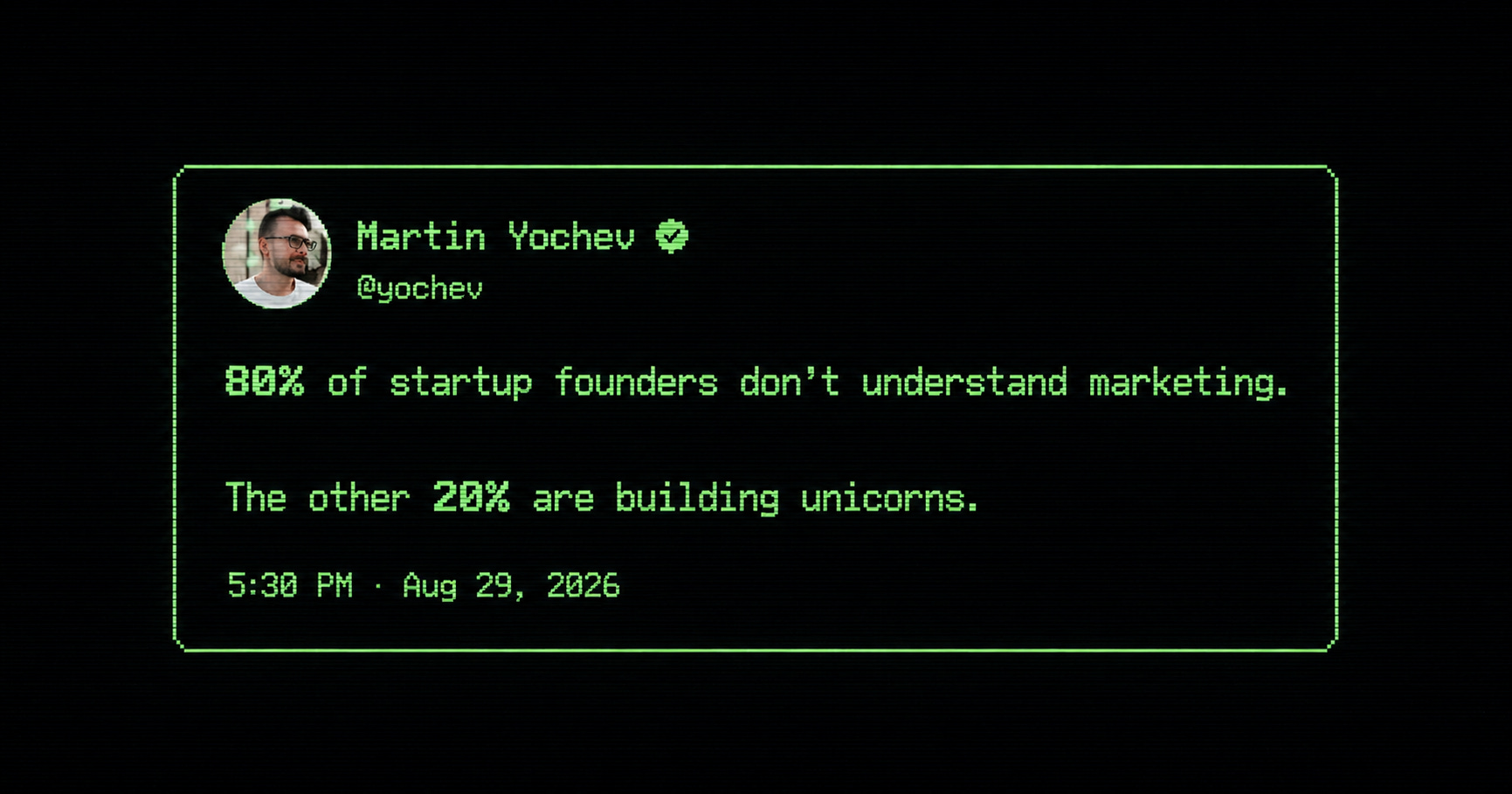
80% of startup founders don’t understand marketing. And it’s costing them real money.
Not because founders are bad at their jobs. Most are excellent at the thing that got the company here: product, sales, fundraising, sheer will. Marketing is just a different discipline, with its own timelines and its own definition of “working,” and most founders never had to learn it before they were suddenly in charge of it.
That gap shows up as one constant, low-grade struggle inside almost every startup marketing team: executing the founder’s sporadic ideas versus doing the work the right way. Here are five places I see it happen, over and over, across companies that otherwise look nothing alike.
The short version
Founders default to instinct, because instinct is what built the company so far. Marketing runs on planning, data, and effort that compounds over months. Put those two operating modes in the same room without translation and you get chaotic priorities, a pipeline full of bad leads, and a marketing hire burning out trying to fix five problems at once. It’s fixable. It just takes a founder willing to name the gap first.
1. Focus
Founders switch priorities chaotically. A competitor’s campaign, a board member’s offhand comment, something that performed well on a founder’s personal LinkedIn post, and the whole team’s roadmap shifts for the week. Each pivot feels small in the moment. Stacked up over a quarter, it makes real planning impossible and puts constant pressure on marketing to show results before anything has had time to work.
2. The basics
Newly hired marketers routinely spend close to half their time just explaining fundamentals to the founders who hired them: why marketing needs a monthly, quarterly, and yearly plan, not a weekly one; why a campaign needs weeks to show a signal, not days. Skip that groundwork and the mismatch shows up downstream, filling the pipeline with “marketing-qualified” leads that were never really qualified. CB Insights lists poor marketing among the top reasons startups fail outright. Not a footnote.
3. Resources
Organic virality is rare, and most paid channels have gotten more expensive, not less. Building a real pipeline takes more than one marketer and a small ad budget, no matter how tempting it is to copy a competitor running a $10M budget and a global team. A good small team can be highly productive. It still can’t out-produce a company with twenty times its resources by sheer effort. The gap isn’t talent. It’s math. Content Marketing Institute puts it starkly: roughly 80% of startups with no dedicated marketing budget fail.
4. Data
Gut calls are fast. Data-driven marketing isn’t, and that’s the trade nobody wants to make out loud. Constant focus-shifting (see #1) makes it nearly impossible to measure anything cleanly, and long B2B sales cycles make the problem worse: the median B2B deal now takes roughly four to five months to close, up 20 to 30% since 2021, so cause and effect on any given campaign can be months apart. For scale, it takes an average of 894 LinkedIn impressions to generate a single website visit from an ideal customer profile match (HockeyStack). None of that shows up in a weekly check-in. It shows up in a quarter.
5. Results
Poor results are rarely one thing. Shifting focus, internal disagreement, thin resources, no benchmark data to argue from, all compounding at once, while marketers are expected to fix every piece of it simultaneously. When results don’t move fast enough, the instinct is to bring in outside help as a patch. To the team already in the room, that usually reads as a vote of no confidence. It tends to do more damage to trust than the original problem ever did.
The truth is
When founders actually understand marketing, the difference is immediate. Ideas flow in both directions instead of one. Communication stops requiring translation. Marketers take real ownership instead of just executing requests, because they’re finally being asked into the strategy instead of handed a list after it’s already been decided.
Founders, how do you make sure you’re actually on the same page as your marketing team, and not just assuming you are?
Frequently asked questions
Why don’t most startup founders understand marketing? Founders are usually strongest in the disciplines that got the company off the ground: product, sales, or fundraising. Marketing runs on a different clock, with results that compound over months instead of days, and most founders never had a reason to learn that rhythm before they were suddenly responsible for it.
What’s the actual fix for founder-marketer misalignment? Shared planning cadence, not more meetings. A founder who reviews marketing on a monthly and quarterly view, alongside the team, closes most of the gap described above. The chaos comes from founders parachuting in with weekly ideas outside that cadence, not from disagreement itself.
How long should a founder give a new marketing hire before judging results? Long enough to match the sales cycle, not the hiring itch. With median B2B deals now taking four to five months to close, a fair read on a marketing hire’s impact usually needs at least one full quarter, and closer to two for anything with a longer enterprise cycle.
Is bringing in outside marketing help always a bad sign? Not inherently, but timing and framing matter. Brought in as a genuine skills gap, external help works. Brought in as a panic response to slow results, it usually reads to the existing team as distrust, and the morale cost tends to outweigh whatever the outside help fixes.
I agree. I am terrible 😂
Because of what you've mentioned. Founders are strong at what they do. Marketing is an after-thought. Learning step by step now. This helps Martin :)